How Much Does Custom Software Development Cost in India in 2026?
If you are planning to build custom software for your business, one of the first questions you will probably ask is:
"How much will it cost?"
Unfortunately, there is no single price for custom software development.
A simple internal business tool and a large SaaS platform may both be described as "custom software," but the amount of design, development, testing, infrastructure, integrations, and ongoing support required can be dramatically different.
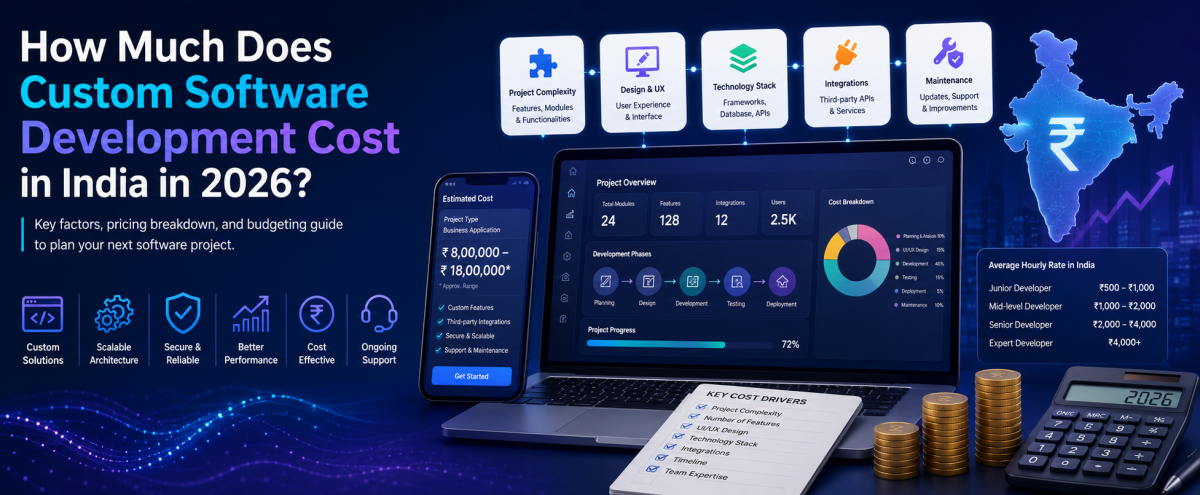
In India, published 2026 pricing guides show a very wide range of estimates because software projects differ significantly in scope and complexity. Some current guides place focused MVPs in the lower-lakh range, while larger business applications and enterprise platforms can reach tens of lakhs or considerably more. The important point is that these figures are planning ranges, not fixed market prices.
This guide explains what actually determines custom software development cost in India and how businesses can create a realistic software budget before starting development.
What Is Custom Software Development?
Custom software development means creating an application specifically for a business, organization, product, or unique workflow.
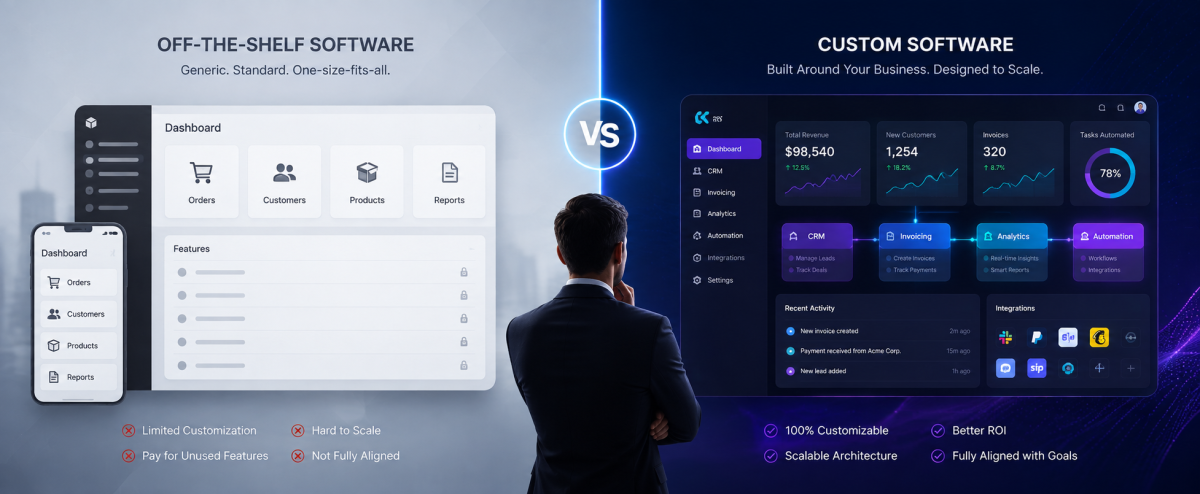
Unlike off-the-shelf software, custom software is designed around the requirements of the business.
For example, a company may need a system that combines:
- Customer management
- Lead management
- Quotations
- Invoicing
- Payments
- Employee management
- Inventory
- Project management
- Reports
- Analytics
- Notifications
- Business automation
Instead of purchasing several disconnected tools, the business can build a centralized platform that connects these processes.
Custom software can also integrate with external services such as payment gateways, accounting systems, shipping platforms, email providers, cloud storage, and third-party APIs.
How Much Does Custom Software Development Cost in India?
There is no universal price because every software project has different requirements.
For planning purposes, custom software projects can generally be thought of in three broad levels:
Project TypeTypical ScopeRelative InvestmentSimple MVP / Internal ToolBasic workflows, dashboard, authentication, limited integrationsLowerBusiness ApplicationMultiple modules, roles, APIs, dashboards, integrationsMediumEnterprise / SaaS PlatformComplex architecture, multiple modules, integrations, scalability, advanced securityHigh
Some 2026 India-focused guides currently cite ranges such as roughly ₹2–5 lakh for a focused SaaS MVP, ₹5–18 lakh for a mid-complexity platform, and ₹20 lakh or more for enterprise-scale systems. Other development firms publish substantially higher ranges, demonstrating why a generic "software development cost" number should not be treated as a quote.
The final price depends on the actual scope.
Why Does Custom Software Cost So Much?
Software development is not simply about writing code.
A professional software project can involve:
- Requirement analysis
- Business process analysis
- UI/UX design
- Database architecture
- Backend development
- Frontend development
- API development
- Third-party integrations
- Authentication and authorization
- Testing
- Security
- Deployment
- Monitoring
- Documentation
- Maintenance
The more complex the requirements, the more effort is required across these areas.
1. Software Complexity
Complexity is one of the biggest factors affecting development cost.
A simple application might contain:
- Login
- User dashboard
- Basic CRUD operations
- Simple reports
A more advanced application could include:
- Multiple user roles
- Complex business rules
- Multi-tenant architecture
- Real-time notifications
- Advanced reporting
- Payment processing
- External APIs
- File management
- Automated workflows
- AI features
- Mobile applications
The second application requires significantly more architecture, testing, and development work.
2. Number of Features
More features generally mean more development effort.
For example, a basic CRM may include:
- Contacts
- Leads
- Notes
- Tasks
A more advanced CRM could include:
- Lead scoring
- Sales pipelines
- Email automation
- Campaign management
- Analytics
- Team permissions
- Custom workflows
- AI-powered recommendations
- Third-party integrations
Therefore, instead of asking only:
"How much does a CRM cost?"
It is better to ask:
"What functionality should the CRM provide?"
3. User Roles and Permissions
Business applications often have multiple types of users.
For example:
- Super Admin
- Business Owner
- Manager
- Employee
- Customer
Each role may have different permissions.
For example, an employee might be able to create a customer but not delete one.
A manager might be able to approve transactions.
An administrator might have access to the entire platform.
Complex permission systems increase development and testing requirements.
4. UI/UX Design
A professional software product needs more than functional screens.
The interface should be:
- Easy to understand
- Responsive
- Consistent
- Accessible
- Efficient
- Optimized for different screen sizes
UI/UX design may involve:
- User research
- Wireframes
- User flows
- Design systems
- Dashboard design
- Mobile layouts
- Prototypes
A good interface can reduce training requirements and improve employee productivity.
5. Backend Development
The backend is responsible for the core business logic of an application.
It may handle:
- Authentication
- Users
- Permissions
- Business rules
- Database operations
- Payments
- Notifications
- APIs
- Background jobs
- File processing
- Reporting
A simple backend may be relatively straightforward.
A complex business platform can require significant architectural planning.
6. Frontend Development
The frontend is the part of the application users interact with.
Modern applications may require:
- Responsive dashboards
- Forms
- Tables
- Charts
- Search
- Filtering
- Notifications
- Real-time updates
- Role-based interfaces
The frontend also needs to communicate reliably with backend APIs.
The complexity of the user interface therefore affects development effort.
7. API Development
APIs become especially important when software needs to communicate with other applications.
For example:
Frontend → API → Backend → Database
A business application may also connect to:
- Payment APIs
- SMS APIs
- Email APIs
- Shipping APIs
- Accounting APIs
- CRM APIs
- AI APIs
Each integration requires development, testing, authentication, error handling, and maintenance.
8. Third-Party Integrations
Integrations can significantly increase software development costs.
For example, an e-commerce platform might require:
- Payment gateway integration
- Shipping integration
- Email integration
- SMS integration
- Accounting integration
- Inventory synchronization
The complexity of an integration depends on the quality of the third-party API, authentication requirements, data synchronization, webhooks, error handling, and business rules.
This is one reason two projects with similar-looking interfaces can have very different development costs.
9. Database Architecture
A good database is fundamental to a scalable application.
Depending on the project, developers may need to design:
- Users
- Customers
- Products
- Orders
- Invoices
- Payments
- Employees
- Permissions
- Transactions
- Audit logs
- Reports
The database also needs to support future growth.
Poor database design can create performance problems later, while a properly designed architecture provides a stronger foundation for scaling.
10. Security Requirements
Security should be considered from the beginning of development.
Depending on the application, security requirements may include:
- Authentication
- Authorization
- Role-based permissions
- Multi-factor authentication
- Encryption
- Secure API access
- Rate limiting
- Audit logs
- Secure file uploads
- Data protection
- Backup strategies
Applications handling financial, customer, employee, or other sensitive information may require additional security controls.
11. Mobile Application Development
If your software needs both web and mobile applications, the development scope increases.
For example:
Web Application + Android + iOS
requires additional UI, testing, device compatibility, notifications, authentication, and deployment considerations.
Some businesses can reduce initial costs by launching a responsive web application first and adding mobile applications later.
12. AI Features
AI can add significant value to modern software products.
Examples include:
- AI chat assistants
- Document processing
- Automated email responses
- Lead classification
- AI-powered search
- Report summarization
- Recommendations
- Workflow automation
- AI agents
However, AI functionality requires more than connecting an AI model.
A production AI feature may require:
- Prompt design
- Data processing
- API integration
- Access control
- Validation
- Monitoring
- Cost management
- Human approval workflows
Therefore, AI requirements should be included in the project scope from the beginning.
Custom Software Development Cost by Project Type
Instead of focusing only on technology, it is useful to consider the type of software being built.
Simple Internal Business Tool
Examples:
- Employee attendance system
- Basic inventory tracker
- Internal dashboard
- Simple booking system
- Small CRM
These applications generally have limited workflows and fewer integrations.
They are usually much less expensive than enterprise platforms.
Medium-Complexity Business Application
Examples:
- CRM
- ERP module
- Service management platform
- Inventory and billing system
- Project management platform
- Customer portal
These systems may include multiple roles, dashboards, APIs, integrations, reports, and complex business logic.
Development costs can therefore increase significantly compared with a simple internal tool.
SaaS Platform
A SaaS application may require:
- Multi-tenancy
- Subscription management
- Billing
- User management
- Organization management
- Role-based access
- API architecture
- Notifications
- Analytics
- Infrastructure
- Backups
- Monitoring
SaaS products also need to be designed with future scalability in mind.
Enterprise Software
Enterprise applications can contain many interconnected modules.
Examples include:
- ERP
- Enterprise CRM
- Logistics platforms
- Large inventory systems
- Financial platforms
- Multi-branch business management systems
Enterprise applications may require advanced security, integrations, scalability, compliance requirements, extensive testing, and long-term support.
What About Software Development Hourly Rates?
Software companies may use different pricing models.
Common approaches include:
Fixed Price
The project is scoped in advance and a fixed price is agreed upon.
This can work well when requirements are clearly defined.
Time and Materials
The client pays based on the actual development effort.
This can be useful when requirements are expected to evolve.
Dedicated Development Team
A dedicated team works continuously on the client's product.
This model can be useful for long-term SaaS products and continuously evolving platforms.
The cheapest hourly rate is not necessarily the cheapest project.
A more experienced team may complete complex work faster, identify architectural problems earlier, and reduce costly rework.
Hidden Costs of Custom Software Development
One of the biggest mistakes businesses make is looking only at the initial development quote.
There can also be ongoing costs.
These may include:
- Cloud hosting
- Domain
- SSL
- Database hosting
- Email services
- SMS services
- API usage
- AI API usage
- Monitoring
- Backups
- Security updates
- Bug fixes
- Feature improvements
- App store fees
- Technical support
These costs should be considered when calculating the total cost of ownership.
How Much Does Software Maintenance Cost?
Software is not finished when it goes live.
After launch, applications need maintenance.
Maintenance may include:
- Bug fixes
- Security patches
- Dependency updates
- Server updates
- Performance improvements
- Database maintenance
- Monitoring
- Backup management
- New features
The actual maintenance cost depends on application complexity and the level of support required.
Businesses should discuss post-launch support before development begins.
How to Reduce Custom Software Development Costs
Building custom software does not mean spending unnecessarily.
There are several ways to control costs.
Start With an MVP
An MVP, or Minimum Viable Product, focuses on the most important functionality.
Instead of building 50 features immediately, start with the features required to validate the product.
For example:
Phase 1
- Authentication
- Core workflow
- Dashboard
- Essential reports
Phase 2
- Advanced analytics
- Automation
- Integrations
- Mobile application
Phase 3
- AI features
- Advanced reporting
- Additional business modules
This approach allows businesses to launch earlier and learn from real users.
Prioritize Features
Not every feature has the same business value.
Divide requirements into:
Must Have
Essential for launch.
Should Have
Important but can wait.
Could Have
Useful but not essential.
Future
Features that can be considered later.
This can significantly improve project planning.
Avoid Unnecessary Customization
Custom development should solve a real business problem.
If an existing third-party service already performs a task reliably, integrating it may be more efficient than rebuilding the same functionality.
Choose the Technology Based on Requirements
Technology should support the business requirements.
The latest framework is not automatically the best framework.
The right stack should consider:
- Project requirements
- Performance
- Scalability
- Security
- Development expertise
- Maintenance
- Integration requirements
- Long-term business goals
How to Evaluate a Software Development Quote
Do not compare software companies only by their final price.
When comparing proposals, review:
Scope
Does the proposal clearly define what will be built?
Features
Are all required modules included?
Design
Is UI/UX design included?
Testing
Does the quote include QA and testing?
Deployment
Does it include production deployment?
Infrastructure
Who manages hosting and cloud infrastructure?
Security
What security measures are included?
Documentation
Will technical and user documentation be provided?
Support
What happens after launch?
Ownership
Who owns the source code and intellectual property?
Change Requests
How are new requirements handled?
A low initial quote can become expensive if important requirements are excluded.
How Long Does Custom Software Development Take?
Development time depends on scope and complexity.
A simple internal tool may take significantly less time than a multi-module SaaS platform.
A typical development process may include:
Discovery → Planning → UI/UX → Development → Testing → Deployment → Support
The timeline can be affected by:
- Number of features
- Number of platforms
- Integrations
- Design complexity
- Feedback speed
- Data migration
- Testing requirements
- Security requirements
- Third-party dependencies
A realistic timeline should therefore be created after understanding the actual requirements.
Should You Build Custom Software or Buy Existing Software?
Before investing in custom development, ask whether existing software already solves your problem.
Off-the-shelf software may be better when:
- Requirements are standard
- You need a solution quickly
- Customization is not important
- Existing products already meet your needs
Custom software becomes more attractive when:
- Your workflows are unique
- Existing software requires too many workarounds
- Multiple systems need to be connected
- Your business needs specialized features
- Software is becoming a competitive advantage
- You need greater control over the product
The decision should be based on business value rather than technology alone.
How to Plan Your Software Budget
A good software budget should include more than development.
Consider these categories:
1. Discovery
Requirements and business analysis.
2. Design
UI/UX and product design.
3. Development
Frontend, backend, database, APIs, and integrations.
4. Testing
Quality assurance and user acceptance testing.
5. Deployment
Servers, cloud infrastructure, domains, and production configuration.
6. Maintenance
Security updates, bug fixes, monitoring, and technical support.
7. Future Development
New features and improvements after launch.
This approach gives businesses a much more realistic view of the investment.
Final Thoughts
The cost of custom software development in India in 2026 cannot be reduced to one fixed number.
A small internal application, a custom CRM, a SaaS platform, and an enterprise system have completely different requirements.
The biggest cost factors are usually:
- Scope
- Complexity
- Number of features
- Integrations
- Platforms
- Security
- AI requirements
- Team expertise
- Timeline
- Long-term maintenance
Instead of asking only:
"How much does software development cost?"
ask:
"What business problem are we solving, what functionality do we need, and what should the first version accomplish?"
That question leads to a much more accurate development budget.
Starting with a clearly defined MVP can also help businesses control initial investment while leaving room to expand the platform based on real customer feedback.
Build Custom Software With FusionCentrix
At FusionCentrix, we help businesses transform their ideas and workflows into custom software, SaaS platforms, APIs, business management systems, and automation solutions.
Whether you need a simple internal application or a scalable business platform, the right development approach starts with understanding your requirements.
We focus on building software around the way your business works rather than forcing your business to adapt to a generic solution.
Have a software idea? Start with the problem, define the requirements, and build the solution that can grow with your business.