Custom Software vs Off-the-Shelf Software: Which Is Right for Your Business?
Choosing the right software can have a major impact on how efficiently a business operates. From managing customers and invoices to handling employees, inventory, communication, reporting, and internal workflows, software has become an essential part of modern business operations.
When businesses need a new software solution, they usually face two options: buy an existing off-the-shelf product or invest in custom software development.
Off-the-shelf software is already developed and can usually be purchased or subscribed to immediately. Custom software, on the other hand, is designed and developed specifically around the requirements of a particular business.
So, which one is better?
The answer depends on your business processes, budget, scalability requirements, integrations, and long-term goals.
In this guide, we will compare custom software and off-the-shelf software and explain when each option makes sense for a growing business.
What Is Off-the-Shelf Software?
Off-the-shelf software is a ready-made application designed for a broad range of businesses or users.
Instead of developing software from scratch, a business subscribes to or purchases an existing solution and configures it according to its requirements.
Common examples include:
- Accounting software
- CRM platforms
- Project management tools
- HR management systems
- Email marketing platforms
- Inventory management software
- Communication tools
- Point-of-sale systems
The main advantage of off-the-shelf software is speed.
A business can often create an account, configure some settings, import existing data, and start using the software without waiting months for development.
This makes ready-made software particularly attractive to startups and small businesses that need a solution quickly.
What Is Custom Software?
Custom software is software specifically designed and developed for a particular business, organization, or workflow.
Instead of changing your business processes to fit an existing application, the software is designed around the way your business actually operates.
For example, a company might need a business management platform that combines:
- Customer management
- Lead management
- Quotes and proposals
- Invoices and payments
- Employee management
- Project management
- Inventory management
- Reports and analytics
- Email communication
- Business automation
If existing software cannot provide the required workflow, a custom application can be designed to bring these functions together.
Custom software can also integrate with existing services such as payment gateways, shipping platforms, accounting systems, cloud storage, communication platforms, and third-party APIs.
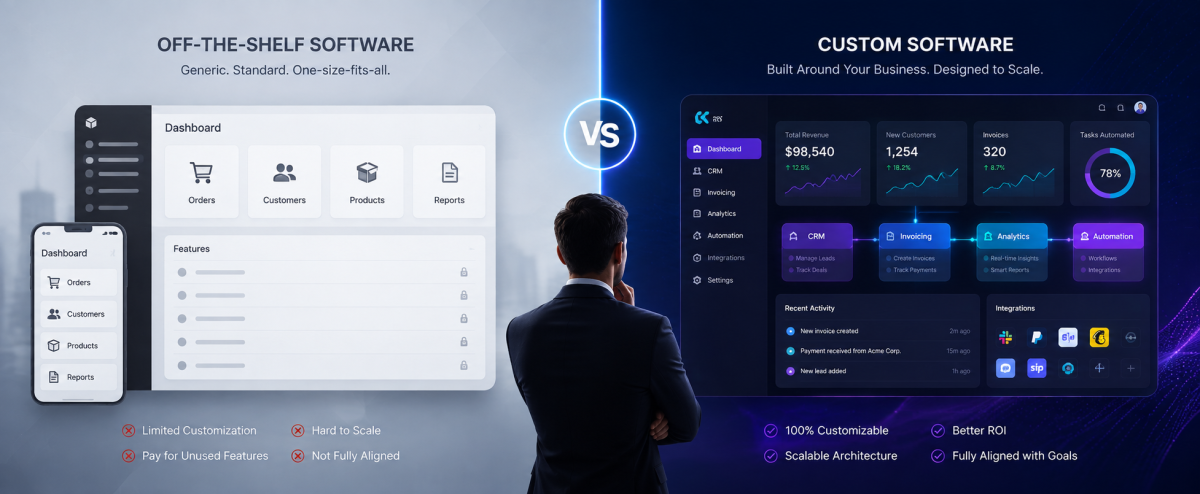
Custom Software vs Off-the-Shelf Software
The biggest difference between the two approaches is flexibility.
With off-the-shelf software, the vendor determines most of the available features and workflows. With custom software, the business determines how the application should work.
FactorOff-the-Shelf SoftwareCustom SoftwareInitial CostUsually lowerUsually higherDeploymentFastRequires development timeCustomizationLimitedHighly customizableScalabilityDepends on vendorDesigned around requirementsIntegrationsSupported integrationsCustom integrations possibleUser ExperienceGeneral-purposeBusiness-specificMaintenanceUsually vendor managedDevelopment team managedOwnershipVendor controlledGreater controlFeaturesPredefinedRequirement-drivenLong-Term FlexibilityLimitedHigh
1. Cost
Cost is often the first consideration when choosing software.
Off-the-Shelf Software
Ready-made software usually has a lower initial cost. Many platforms use subscription-based pricing, allowing businesses to pay monthly or annually.
This can make it easier for a small company to start using professional software without a large upfront investment.
However, subscription costs can increase as the business grows.
For example, a company may initially pay for five users but eventually need 50 or 100 users. Additional modules, storage, integrations, and premium features may also increase the total cost.
Custom Software
Custom development usually requires a larger initial investment.
The cost can include:
- Business analysis
- UI/UX design
- Backend development
- Frontend development
- Database architecture
- API development
- Testing and quality assurance
- Deployment
- Security implementation
- Maintenance and support
However, custom software can provide greater control over the product and its future development.
Businesses should therefore evaluate the total cost of ownership rather than looking only at the initial development cost.
2. Customization and Flexibility
Customization is one of the biggest advantages of custom software.
Every business has different workflows.
For example, one company may require:
Lead → Quotation → Approval → Project → Invoice → Payment
Another business might have:
Customer → Service Request → Technician Assignment → Service Completion → Invoice → Payment
A generic software product may not support these workflows exactly as required.
Custom software allows developers to build workflows specifically around the organization's processes.
This can reduce unnecessary manual work and eliminate complicated workarounds.
3. Scalability
Business requirements change as a company grows.
A startup might initially need only customer management and invoicing. Later, it may require:
- Multiple branches
- Multiple employees
- Advanced user permissions
- Inventory management
- Automated billing
- Advanced analytics
- Mobile applications
- Third-party integrations
- AI-powered automation
With off-the-shelf software, you are generally limited by the vendor's roadmap and available plans.
With custom software, new functionality can be added based on business priorities.
A properly designed custom application can therefore evolve alongside the organization.
4. Integration With Other Systems
Modern businesses rarely use only one application.
A company may need to connect:
- CRM systems
- Accounting software
- Payment gateways
- Email services
- SMS platforms
- Shipping providers
- Cloud storage
- Analytics platforms
- Internal business systems
- Mobile applications
Off-the-shelf products often provide integrations with popular services.
However, if your business depends on a less common system or has a unique workflow, integration can become difficult.
Custom software allows APIs and integration layers to be designed specifically for those requirements.
5. Security and Data Control
Security is another important consideration when choosing a software solution.
With off-the-shelf software, your data and infrastructure are generally managed according to the vendor's architecture and security policies.
A reputable software provider may offer strong security controls, backups, encryption, authentication, and monitoring.
However, businesses may still have limitations regarding infrastructure control and customization.
Custom applications can be designed around specific security requirements, including:
- Role-based access control
- Multi-factor authentication
- Secure API authentication
- Data encryption
- Audit logs
- Permission management
- Secure database architecture
- Custom backup strategies
It is important to remember that custom development does not automatically mean better security. Security depends on how the application is designed, developed, deployed, and maintained.
6. User Experience
Off-the-shelf applications are designed for a broad audience.
As a result, they often include many features that your employees may never use. This can make the interface more complicated than necessary.
Custom software can be designed around the exact tasks employees perform every day.
For example, instead of navigating through multiple screens to create an invoice, a custom system could provide a workflow specifically optimized for the company's billing process.
A better user experience can reduce training requirements and improve employee productivity.
7. Ownership and Long-Term Control
With many SaaS products, businesses are essentially renting access to software.
The vendor controls important aspects such as:
- Product roadmap
- Pricing
- Features
- Infrastructure
- Updates
- Availability
This is not necessarily a problem, but businesses should understand the dependency on the software provider.
Custom software provides significantly more control over the application's functionality and future development.
Depending on the development agreement, businesses can have control over the source code, infrastructure, database, integrations, and future development roadmap.
This can be particularly important for companies whose software becomes a core part of their operations.
8. When Should You Choose Off-the-Shelf Software?
Off-the-shelf software can be the better choice when:
- Your requirements are relatively standard
- You need software immediately
- Your budget is limited
- You do not require complex customization
- Existing software already solves your business problem
- You do not need specialized integrations
- You prefer vendor-managed maintenance
For example, if you simply need standard project management functionality, purchasing an established project management platform may be more practical than developing one from scratch.
There is no reason to build custom software when an existing product already solves the problem effectively.
9. When Should You Choose Custom Software?
Custom development becomes more attractive when:
- Your business has unique workflows
- Existing software does not meet your requirements
- You need multiple systems integrated
- You require specialized reporting
- Your business is rapidly growing
- You require complex user permissions
- Software is a competitive advantage for your business
- You need greater control over your application
- Existing subscriptions are becoming expensive
- Manual processes are consuming significant time
If employees constantly use spreadsheets, copy data between applications, manually generate reports, or maintain complicated workarounds, it may be a sign that custom software could provide significant value.
10. A Hybrid Approach Can Also Work
Businesses do not always have to choose one option exclusively.
A hybrid strategy can sometimes be more effective.
For example, a company might use:
- An existing accounting platform
- A custom CRM
- A custom internal dashboard
- A third-party payment gateway
- Cloud infrastructure
- An external email service
The custom application can become the central platform connecting different systems.
This approach allows businesses to avoid rebuilding functionality that already exists while still solving their unique operational requirements.
How to Decide Which Option Is Right for Your Business
Before making a decision, ask the following questions:
1. Are your business processes standard?
If your requirements are common and well supported by existing products, an off-the-shelf solution may be enough.
2. Do you need unique workflows?
If your business operates differently from standard industry workflows, custom development may be more suitable.
3. How many systems need to communicate?
The more integrations your business requires, the more valuable a flexible software architecture can become.
4. How quickly do you need the solution?
If you need something immediately, off-the-shelf software may be preferable. Custom software requires planning, development, testing, and deployment.
5. How important is long-term scalability?
If the application will become a core business platform, custom development may provide greater flexibility as your organization grows.
6. What is the total cost over several years?
Do not compare only the initial development cost. Consider subscriptions, upgrades, integrations, additional users, customization fees, maintenance, and operational costs.
Custom Software vs Off-the-Shelf Software: Final Verdict
There is no universal answer to whether custom software or off-the-shelf software is better.
Off-the-shelf software is often the right choice when your requirements are common, your budget is limited, and you need a solution quickly.
Custom software becomes more valuable when your business has unique processes, requires complex integrations, needs greater control, or wants software that can evolve with the organization.
The best approach is to first understand the business problem and then choose the technology.
Software should support the business — not force the business to completely change its processes just to fit the software.
If your current tools require employees to maintain spreadsheets, repeatedly enter the same information, manually transfer data between systems, or use complicated workarounds, it may be worth evaluating whether a custom software solution could improve your operations.
Build Software Around Your Business
At FusionCentrix, we help businesses turn their specific workflows and ideas into scalable software solutions, APIs, SaaS platforms, and business automation systems.
Whether you need a custom business application, API integration, SaaS platform, internal management system, or automation solution, the right architecture can help your business operate more efficiently and scale with confidence.
The right software does more than solve today's problems — it creates a foundation for tomorrow's growth.