As a business grows, its operations usually become more complicated.
Leads come from different channels. Customer information is stored in multiple places. Employees use spreadsheets to track work. Accounts are maintained separately. Reports take time to prepare, and managers often have to depend on different tools just to understand what is happening inside the business.
At FusionCentrix, we believe technology should simplify these processes rather than make them more complicated.
At some point, adding another spreadsheet or subscribing to another disconnected tool doesn't solve the problem. This is where custom software development can make a significant difference.
Instead of adapting your business processes to generic software, a custom system can be designed around the way your business actually works.
1. When Spreadsheets Start Becoming a Problem
Spreadsheets are useful when a business is small and processes are simple. But as the volume of information increases, managing everything manually can become difficult.
Common problems include:
- Duplicate customer information
- Multiple versions of the same spreadsheet
- Manual data entry
- Difficulty tracking leads
- Delayed reports
- Limited visibility for managers
- Human errors
- Repetitive administrative work
The problem isn't the spreadsheet itself. The problem is when your business starts depending on spreadsheets for processes that should be connected and automated.
2. What Is Custom Business Software?
Custom business software is a digital system designed specifically around an organization's workflows.
Instead of purchasing a generic platform and changing your processes to fit it, custom software is developed around your actual requirements.
For example, a business may need a single system that combines CRM, lead management, employees, accounts, inventory, and reporting.
The exact modules depend on the business. A service company may need CRM and project management, while a retail business may need inventory, purchasing, sales, and customer management.
Learn more about FusionCentrix custom software development services and how business applications can be built around specific workflows.
3. Connect Your Business Data in One Place
One of the biggest advantages of custom software is having connected information.
A new lead can enter the CRM, the sales team can follow up, the customer can become an active client, a project can be created, invoices can be generated, and payments can be recorded — all within a connected digital workflow.
Instead of maintaining separate files for every stage, information can move between connected modules. This gives business owners and managers a clearer view of their operations.
For businesses that need browser-based systems and connected applications, FusionCentrix web application development provides a scalable foundation for these workflows.
4. Automate Repetitive Work
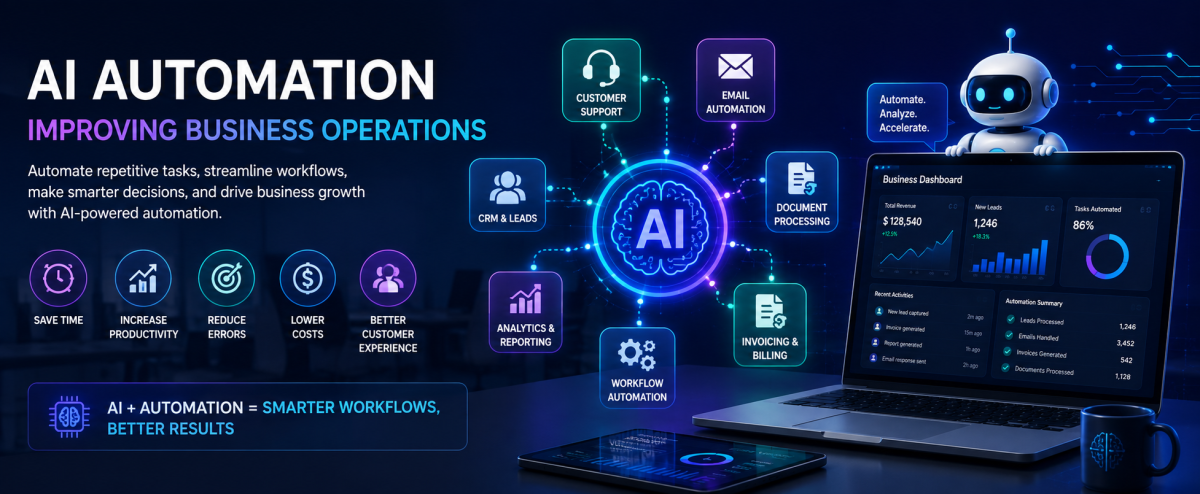
Not every business task requires a person to perform the same action repeatedly. Custom software can automate workflows and reduce unnecessary manual work.
Examples include:
- Lead assignment
- Follow-up reminders
- Invoice generation
- Employee notifications
- Approval workflows
- Email notifications
- Customer status updates
- Report generation
- Data synchronization
- Recurring administrative tasks
Automation doesn't replace the people running the business. It reduces repetitive work so employees can focus on activities that require judgment, communication, and expertise.
5. Make Better Decisions with Business Data
Having data is not enough. Businesses need to be able to understand it.
A custom dashboard can bring important information into one place and help management understand what is happening across different parts of the business.
Sales: Total leads, conversions, revenue, and pending deals.
Finance: Invoices, payments, outstanding amounts, and expenses.
Employees: Attendance, workload, performance, and assigned tasks.
Operations: Orders, inventory, customers, suppliers, and ongoing activities.
Instead of manually collecting information from different files, decision-makers can access relevant information through a centralized system.
6. Build Software Around Your Workflow
Every business operates differently.
A generic software platform may provide dozens of features, but that doesn't necessarily mean those features match your workflow.
Custom software allows you to define:
- User roles
- Permissions
- Business rules
- Approval processes
- Dashboard requirements
- Notifications
- Reports
- Integrations
- Data structures
- Automated workflows
The result is software that works with your business instead of forcing your business to work around the software.
7. Connect Your Existing Tools
Custom software doesn't necessarily mean replacing everything you already use. Modern systems can integrate with other platforms through APIs and third-party services.
For example, your business system could connect with:
- Payment gateways
- WhatsApp Business solutions
- Email services
- Accounting systems
- E-commerce platforms
- Shipping services
- Marketing platforms
- External databases
- Cloud services
This allows your existing technology ecosystem to work together more efficiently.
8. Security and Access Control Matter
Business software contains valuable information. Customer records, financial information, employee data, business documents, and operational data should not be accessible to everyone.
A properly designed system can implement role-based access and permissions.
Administrator: Full system access.
Manager: Access to relevant operational and reporting information.
Sales Team: Access to leads, customers, and sales activities.
Accounts Team: Access to invoices, payments, and financial workflows.
This provides better control over who can access and modify business information.
9. Custom Software Can Grow with Your Business
Your business today may not look the same three years from now.
You may add:
- New employees
- New branches
- New products
- New services
- New customers
- New sales channels
- New integrations
A well-planned software architecture can evolve with those requirements.
Instead of replacing the entire system every time your business changes, new modules and capabilities can be introduced as your requirements grow.
10. When Should You Consider Custom Software?
Custom software may be worth considering when:
- Your team spends significant time on repetitive data entry.
- Multiple departments use disconnected systems.
- Management lacks a clear view of business data.
- Your existing software doesn't match your workflow.
- You are managing important operations through spreadsheets.
- Manual processes are causing errors or delays.
- You need integrations between multiple platforms.
- Your business requires specific workflows that generic software doesn't support.
The goal shouldn't be to build custom software simply because you can.
The goal should be to solve a real business problem.
Build Software Around Your Business with FusionCentrix
At FusionCentrix, we design and develop custom digital solutions around real business requirements.
From custom business software and CRM systems to HRM, inventory management, dashboards, workflow automation, APIs, and custom business applications, we help businesses turn manual processes into connected digital workflows.
We also build web and app solutions for businesses that need scalable digital platforms across web and mobile.
For businesses that need better customer-facing experiences, our UI/UX design services help create clear and user-friendly digital products.
We believe technology should adapt to the way your business operates — not the other way around.
Ready to Move Beyond Spreadsheets?
Let's discuss your workflow and explore what can be automated, connected, and improved.